

Ghana: When the global fashion system turns a country into a dumping ground
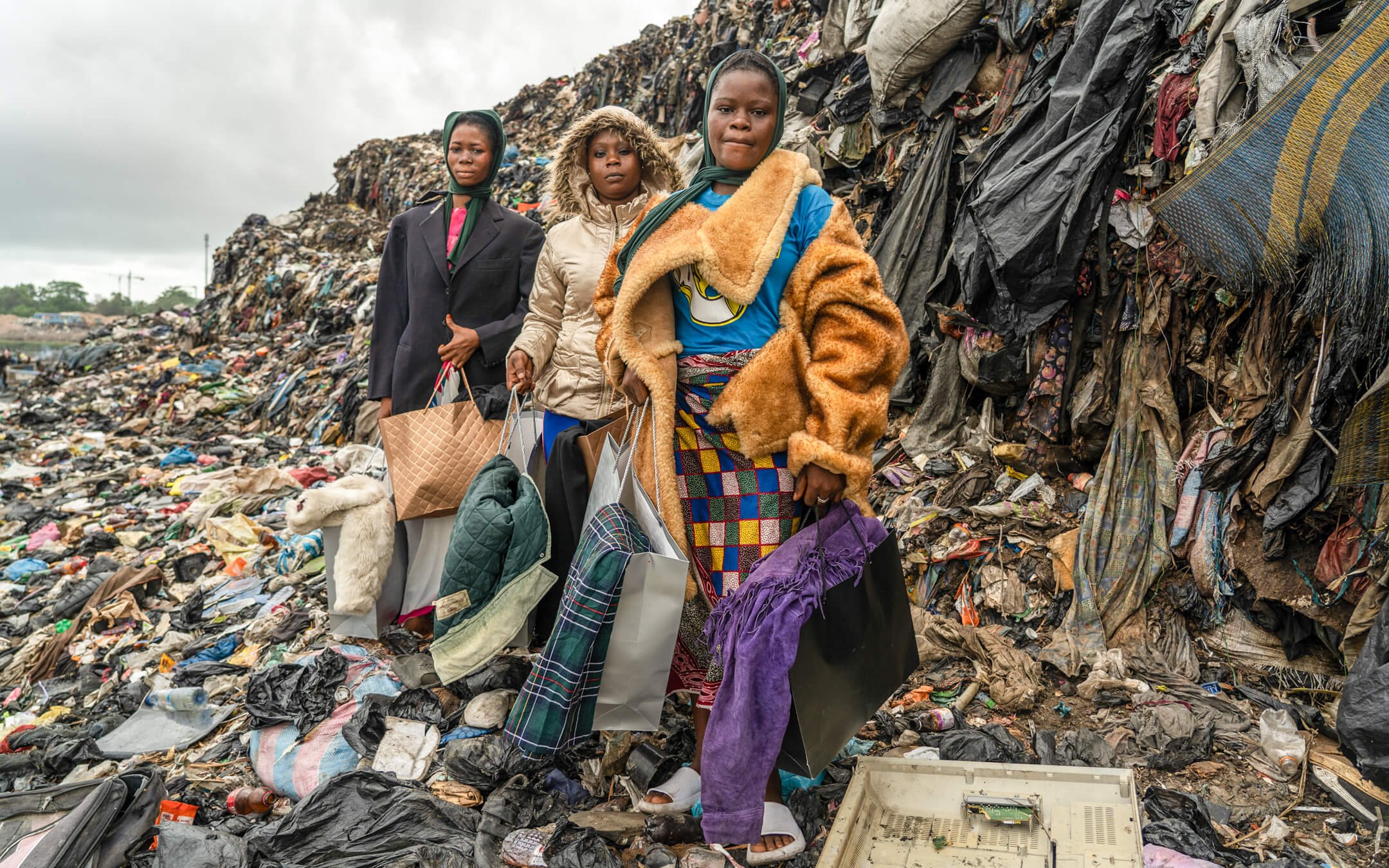
Ghana was never meant to become one of the world’s largest textile waste destinations.
Yet today, it stands at the frontline of a global fashion system in crisis — absorbing the physical consequences of overproduction, overconsumption and poorly regulated second-hand trade.
What is happening in Ghana is not marginal.
It is structural.
And it reveals a truth the global retail industry can no longer ignore.
Kantamanto: from retail ecosystem to saturation point
For decades, Ghana and particularly Accra’s Kantamanto Market, has been a central hub for second-hand clothing in West Africa.
This informal but highly sophisticated retail ecosystem supports tens of thousands of livelihoods, from traders and tailors to logistics workers.
Every week, millions of garments arrive in Ghana, mainly from Europe and the UK, sold as “reusable” second-hand clothing.
But the quality of these imports has dramatically deteriorated.
Today, up to 40–50% of incoming clothes are unsellable upon arrival.
They are not second-hand goods. They are waste.
This marks a turning point : Ghana is no longer a redistribution market, it is becoming an end-of-life destination.
When waste leaves the market and enters nature
Once rejected by traders, these clothes do not disappear. They move into landfills, waterways and increasingly into protected natural areas.
Investigations have documented textile waste dumped in and around the Densu Delta, a Ramsar-protected wetland west of Accra.
This ecosystem is internationally recognised for its biodiversity, coastal protection and importance to fishing communities.
Synthetic garments accumulate in lagoons and mangroves, releasing microplastics, blocking water flows and damaging fragile habitats.
What ends up in Ghana’s wetlands is not a by-product of local consumption. It is the residue of global retail excess.
Ghana is paying the hidden cost of fast fashion
This crisis exposes a brutal asymmetry.
Consumers in wealthy markets discard clothes at record speed.
Brands continue to produce at volumes disconnected from durability or reuse.
And Ghana absorbs the environmental, social and infrastructural cost.
The consequences are concrete:
Pollution of fishing zones and freshwater sources
Increased flooding risks due to blocked drainage systems
Health hazards for communities living near dumping sites
A retail ecosystem under strain, forced to manage waste it did not generate
This is not a failure of Ghana’s waste management alone. It is a failure of the global fashion value chain.
The myth of “second-hand sustainability”
Second-hand trade is often framed as a sustainability solution.
In Ghana, it has historically been a form of economic resilience and access. But the current system no longer resembles circularity.
When brands offload low-quality garments under the label of reuse without responsibility for end-of-life, second-hand trade becomes a waste export mechanism.
Sustainability cannot mean shifting environmental damage from North to South.
What Ghana reveals to the global retail industry
Ghana is not an exception. It is a mirror.
It shows what happens when :
Overproduction meets weak regulation
Retail growth ignores downstream impact
Responsibility ends at the point of sale
For global brands, the lesson is clear :
Retail strategy cannot stop at market entry or sales performance. It must account for where products go when markets reject them.
Why this matters for Africa and beyond
Africa is often discussed as a growth market.
Ghana reminds us it is also treated as a buffer zone for the failures of global systems.
At BAICI, we see this as a critical retail intelligence issue.
You cannot claim to understand African markets while ignoring:
the environmental load imposed on them
the informal economies forced to absorb global inefficiencies
the political and social risks that follow
Ghana’s situation is not a local anomaly. It is a warning signal.
Toward accountability, not displacement
Real solutions require:
Extended Producer Responsibility frameworks that include export markets
Quality thresholds for second-hand trade
Investment in local textile recycling and circular infrastructure
Data transparency across borders
Above all, they require a shift in mindset:
Africa is not the end of the line.
It is part of the system — and deserves to be treated as such.
BAICI Insight
Ghana is not “failing” the fashion system. The fashion system is failing Ghana. And until retail strategies integrate environmental and social impact as core data points, this failure will continue quietly exported, visibly destructive.